
What is CPAP, how does it work, and who is it suitable for?
Last updated:
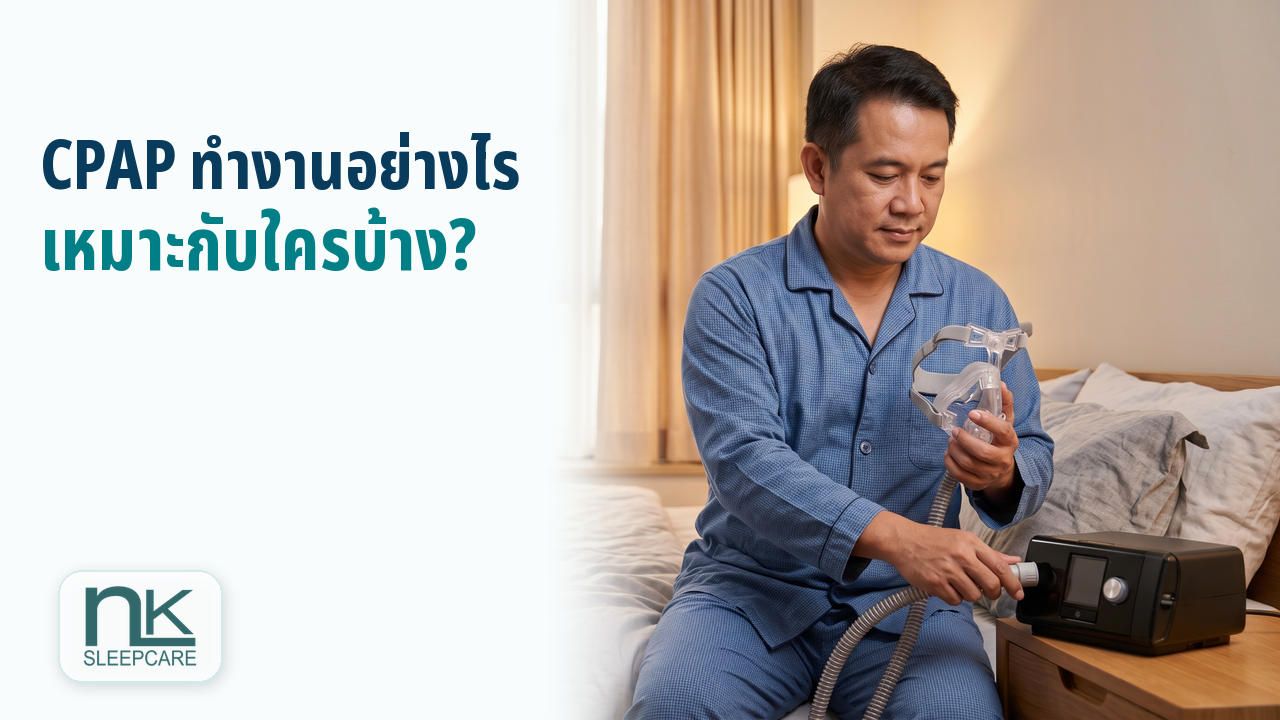
CPAP, pronounced "CPAP," stands for Continuous Positive Airway Pressure. It's a machine that draws room air, creates pressure, and then delivers it through a tube and mask to help maintain the upper airway and prevent it from narrowing or closing during sleep. Therefore, it's widely used to treat adults diagnosed with obstructive sleep apnea (OSA). [1,5]
CPAP machines are not something everyone can buy and use on their own. Before starting use, a doctor should diagnose any underlying medical conditions, and then the doctor or care team can help select the right mask, set up the machine appropriately for the user, and monitor progress after starting use. [1,3]
What is CPAP and what is it not?
The term "Continuous Positive Airway Pressure" literally translates to "continuous positive pressure in the airway." In practical use, the device draws ambient air through a filter and creates pressure to send it through a tube to the mask. This air pressure helps keep the airway open during both inhalation and exhalation while sleeping.
Many people refer to CPAP as a "sleep breathing machine," "sleep aid," or "snoring machine." While these terms are generally understood, CPAP is not an oxygen concentrator, nor does it replace the user's breathing. The user still breathes in and out independently.
If your doctor determines that supplemental oxygen is needed, the doctor and care team will prescribe the appropriate method of use and equipment. You should not connect oxygen to a CPAP machine or modify the equipment yourself. [5]
CPAP doesn't solve all types of snoring, as snoring can be caused by sleeping position, nasal congestion, nasal and throat structure, alcohol, or a combination of factors. In cases of Obstructive Sleep Apnea (OSA), the machine helps prevent airway narrowing or blockage during use, but it doesn't permanently alter these structures. Therefore, snoring or sleep apnea may return on nights without the machine. [5]
How does CPAP work on the airways during sleep?
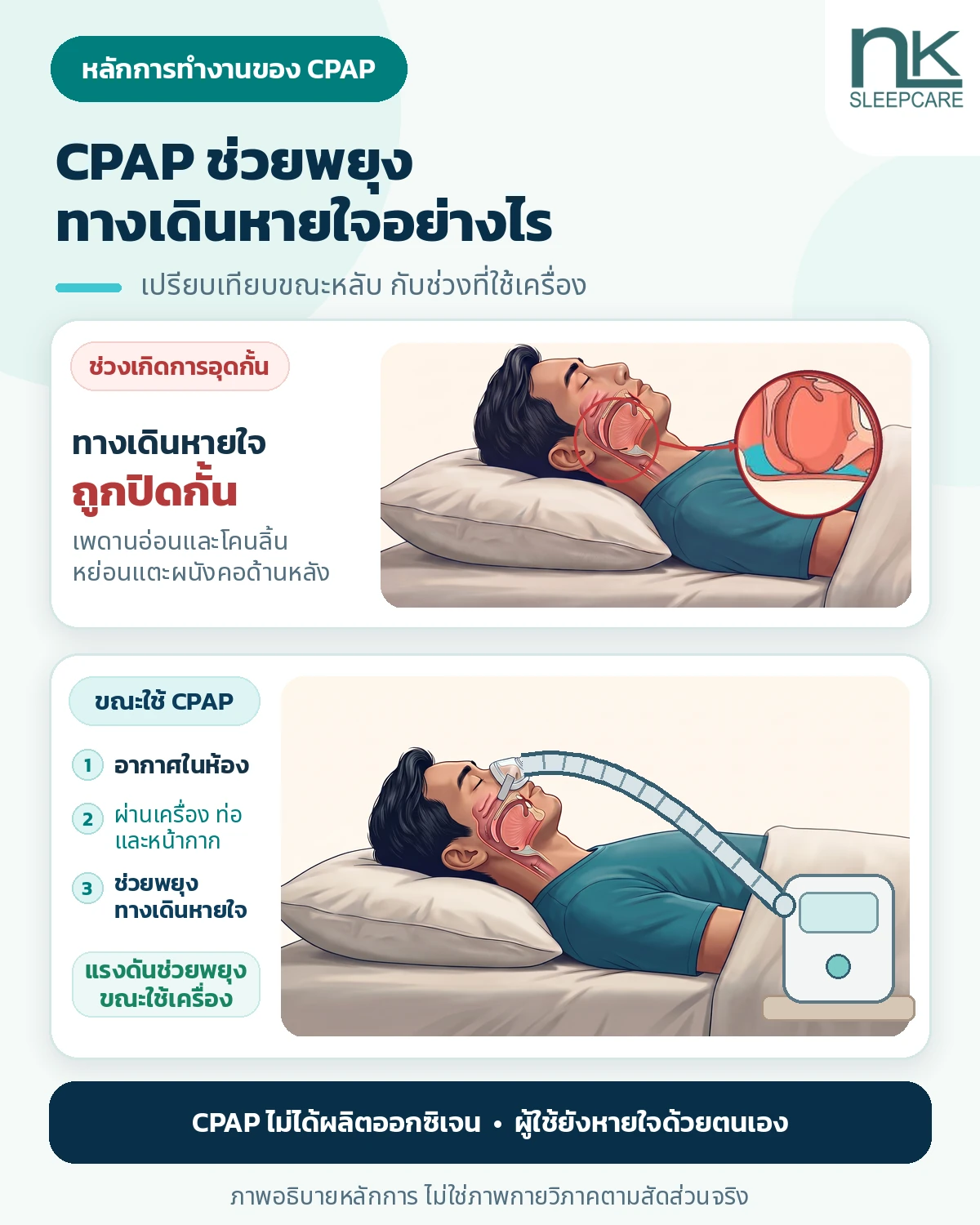
When we sleep, the muscles in the neck naturally relax. In people with OSA (Obstructive Sleep Apnea), the upper airway may narrow or close intermittently, reducing or temporarily stopping airflow. This narrowing or closing may recur, leading to interrupted sleep.
The pressure from a CPAP machine helps maintain the airway, preventing it from narrowing or closing during sleep. The user continues to breathe on their own; the machine doesn't force air into the lungs to compensate. The airflow path can be simply explained as follows:
- Room air enters the machine through a filter.
- Air pressure generators of specified types and values.
- Air travels through the air duct to the mask.
- The mask applies pressure to the nose, or both the nose and mouth, depending on the type of mask.
- Pressure helps support the upper airway while sleeping.
When the pressure is appropriate, the mask fits snugly, and the device is used adequately, airway obstruction tends to occur less frequently during use. Snoring caused by airway stenosis may also decrease. However, a reduction in snoring alone does not indicate good OSA control; symptoms, data from the device, and follow-up results must all be considered. [1,2]
Who might a doctor recommend PAP to?
PAP (Positive Airway Pressure) is a general term for devices that use pressurized air to help open the airway, including CPAP. Doctors will consider using PAP after confirming OSA (Obstructive Sleep Apnea), taking into account symptoms, severity, underlying medical conditions, and the impact on daily life. A decision should not be made solely based on snoring or the apnea-hypopnea index (AHI). [1,3]
A doctor may consider several factors together, such as:
- Sleep study results and details of abnormal breathing during sleep.
- The severity and frequency of daytime sleepiness, feeling unrested upon waking, or decreased concentration.
- Impacts on safety, such as drowsiness while driving or operating machinery.
- Pre-existing medical conditions, especially heart, vascular, or lung diseases, or conditions that affect breathing.
- Breathing patterns, weight, sleeping position, and factors that worsen symptoms.
- Treatment goals, readiness, preferences, and ability to use the device continuously.
- Results for determining optimal pressure and follow-up data after initial use, when deemed necessary by the physician.
The Average Health Impact Assessment (AHI) is the average number of times per hour that a person experiences apnea or shallow breathing during a sleep study. It's one piece of information doctors use to assess OSA (Obstructive Sleep Apnea), but you shouldn't assume that "everyone with an AHI over 5 needs a CPAP machine" based solely on this number. Doctors must consider the patient's symptoms, underlying conditions, safety risks, sleep study results, and other treatment options. [1,3,4]
If you're unsure whether you have OSA (Obstructive Sleep Apnea), start by describing your symptoms to your doctor and discussing what type of sleep study and where would be most suitable. Those considering home sleep studies can read more here. Procedures for receiving sleep monitoring services at home This will allow you to prepare yourself and have questions ready before your appointment.
If you have test results, take the report along with the prescription or instructions you received to discuss the device, mask, and pressure settings with your doctor. Do not choose an automatic pressure-adjusting machine (Auto CPAP or APAP) simply because you think it will automatically detect illnesses and select the appropriate pressure. [1,2]
What are the differences between CPAP, Auto CPAP, and BiPAP?
Easy-to-read summary
What are the differences between CPAP, APAP, and BPAP?
CPAP, APAP, and BPAP are all devices in the PAP (Patient Applied Therapy) category. But they differ in the method of delivering pressure.
Fixed CPAPConstant pressure CPAP
- Pressure pattern
- Delivers a consistent pressure level throughout the operating range.
- Things you should know
- The pressure reading should be based on test results and settings from your doctor or care team.
APAPAuto CPAP
- Pressure pattern
- Automatically adjusts the pressure up or down within a set range.
- Things you should know
- Even with "automatic" devices, pre-operative medical checks are still required, a doctor or healthcare team must determine the pressure range, and follow-up monitoring is necessary after initial use.
BPAPOften referred to as BiPAP.
- Pressure pattern
- The pressure exerted during inhalation and exhalation is not equal.
- Things you should know
- A doctor may choose to use the device in certain cases, based on breathing patterns, underlying medical conditions, required pressure, and comfort while using the machine.
It should not be concluded that BiPAP is only for “severe OSA”.
The table above summarizes how CPAP, APAP, and BPAP deliver pressure differently. Your physician will consider sleep study results, symptoms, underlying conditions, comfort levels, and data from the device after initial use to select the appropriate PAP type and treatment settings. Users should not change modes or adjust pressure manually. [1,2,5]
What components are included in a CPAP machine, and why is the mask important?
A CPAP system isn't just a machine; its main components work together as a set, including:
- Pressure generator Air is drawn through the filter and pressurized to the specified value.
- air filter It helps filter dust before the air enters the machine. The type, maintenance, and replacement intervals vary depending on the model.
- Air duct It directs air from the machine to the mask. Some systems support heating tubes.
- Masks or face contact parts Applying pressure to the airways.
- Headband Secure the mask in the proper position.
- Humidifiers It can be integrated into the device or used as an accessory, helping to increase the humidity in the air it emits.
There are several types of CPAP masks, such as nasal masks, pillow masks, and full-face masks. No single type is suitable for everyone. The choice depends on face shape, whether you breathe through your nose or mouth, your sleeping position, pressure level, skin sensitivity, discomfort, and leakage during movement.
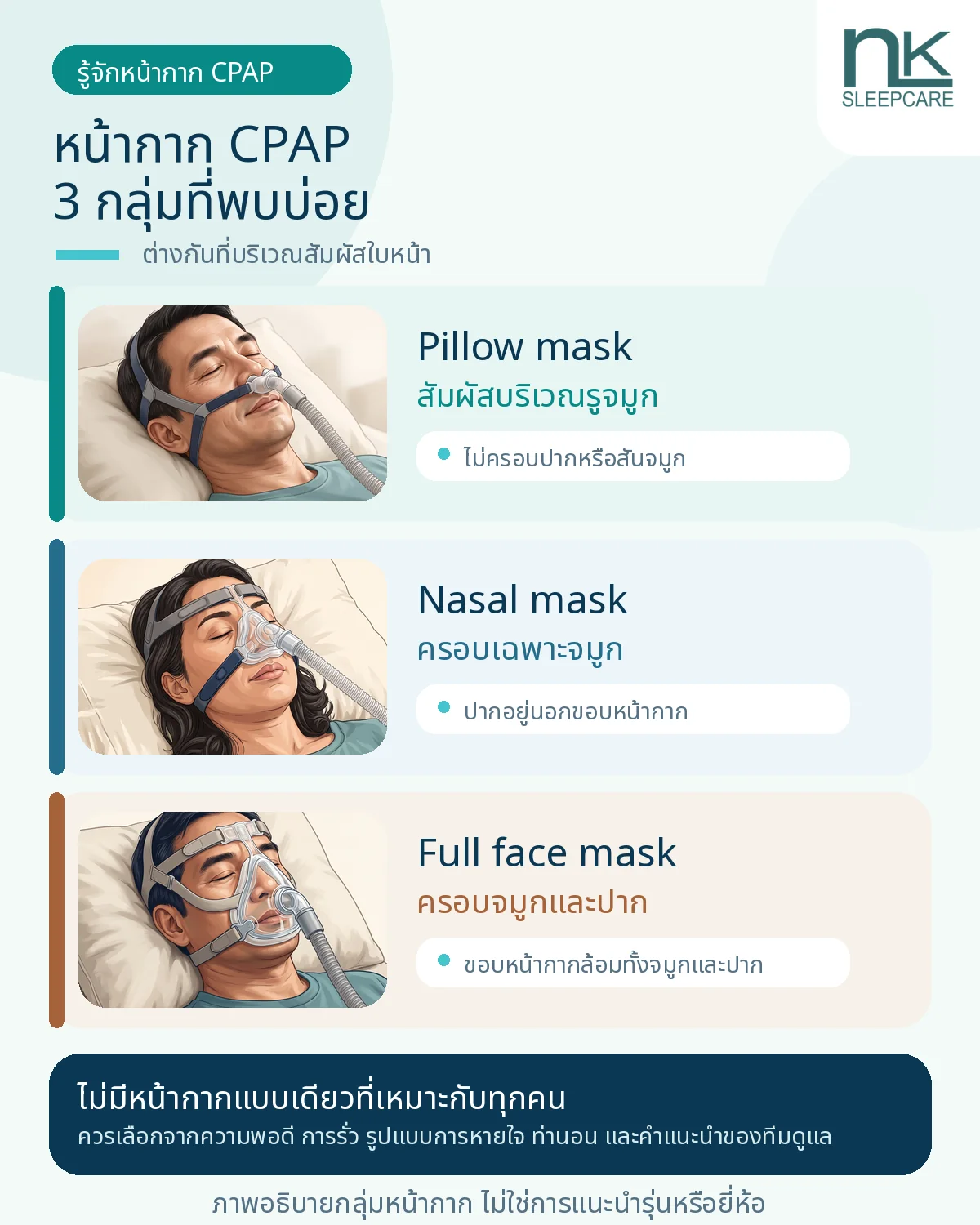
A mask that is too small or too large may leak, while tightening it too much to stop air leaks may cause pain or pressure marks. Therefore, it's best to try on the size, position the mask, and check while actually lying down. Sometimes, replacing the mask cushion (the part that fits against the face) or changing the type of mask may solve the problem more effectively than replacing the entire unit. For information on the differences between different mask types and how to find the right fit, read on. How to choose the right CPAP mask for you. yes
Some CPAP users experiencing dry throat often purchase a chin strap to use themselves, believing it will solve the problem. In reality, a chin strap may help reduce mouth opening or air leakage in some CPAP mask users, but it may not be effective for everyone. Therefore, it is advisable to have a doctor assess its suitability. [7,8]
In addition to CPAP masks coming in many types and sizes, The various components in the set. There are many different models and types available. When starting out, you may not need to buy a humidifier or accessories, or choose one with every function from the beginning. Instead, you should choose based on your specific needs, breathing patterns, comfort, model-specific manual, and individual usage. [2]
How to start using CPAP safely and easily for continued use.
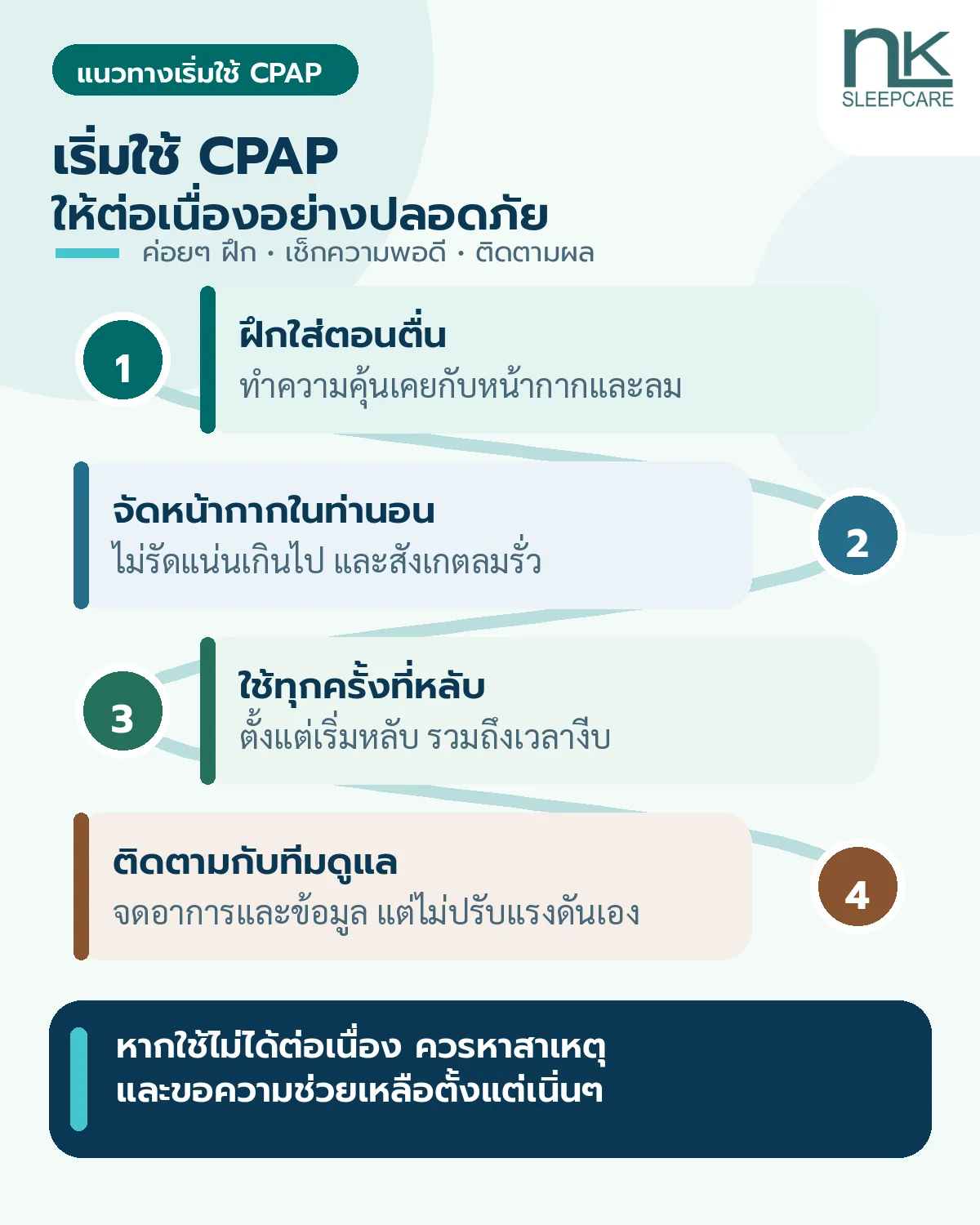
A CPAP machine should be used every time you sleep, both at night and during naps, because the machine only helps keep the airway open while the mask is on. If you only use it for short periods and then remove it and continue sleeping, the airway may constrict or close again during the times it's not being used. [2,5]
Before the first night, check that the type of machine, mode, pressure range or setting, and accessories match those specified by your doctor or care team. You should also know how to assemble the tubing, fill with water (if using a humidifier), adjust the mask, and turn the machine on and off according to the model's manual. Place the machine stably, ensure that nothing obstructs the air intake, and keep the power cord and tubing out of reach of any potential tripping hazards or that could pull the mask down.
The placement of the device should follow the model's manual, especially when using a humidifier, as some models require the unit to be positioned below the mask level. Avoid carpets or fabrics that may obstruct the air intake, and keep the area around the device clean and free of food debris or insects.
Ways to help you adapt more easily include:
- Try wearing a mask for short periods while awake to get used to the feel and the wind.
- Adjust the mask to a realistic lying position, making sure it's not too tight, and check for any air leaks into your eyes.
- When going to bed, put on the mask and turn on the device before you fall asleep. Don't wait until you've fallen asleep to put it on.
- If you encounter a problem, write down the symptoms, when they occurred, and how they happened to help the care team more easily identify the cause.
- Follow up as scheduled, monitoring usage hours, air leaks, and treatment outcomes, not just the number of hours used.
- Seek help early on; don't wait until you feel discouraged and stop using the service for a long time.
The figure of "4 hours" is often used in research, and the Social Security Office uses this figure as part of its reimbursement criteria. However, a CPAP machine is only effective when it's inserted and turned on. If you sleep for 7 hours but only use the machine for 4 hours, the remaining 3 hours are not spent using it. Therefore, using it for 4 hours doesn't necessarily mean it's sufficient for everyone. Ideally, you should insert the machine every time you sleep and continue using it until you wake up. For other insurance coverage, please check the conditions directly with your insurance provider. [2,9]
After starting to use the device, don't just focus on how many hours it's been running. You should also check if the mask is leaking, how much abnormal breathing patterns the device is detecting, if you're still waking up frequently or feeling sleepy during the day, and whether the readings from the device accurately reflect your symptoms.
The numbers for each night can vary depending on sleeping position, sleep time, nasal congestion, or air leaks. Therefore, you should not adjust the device yourself based on a single night's reading. It's best to have a support team periodically review the data to determine if the problem lies with usage time, the mask, the equipment, the pressure settings, or other causes. [1,4]
If you don't get a full night's sleep on the first night, it doesn't mean you should give up. Find the cause and fix it safely, such as adjusting how you wear the mask, managing humidity, or using functions that make you more comfortable. Follow the manual and instructions from the support team, but you should not try to solve the problem by reducing pressure or changing modes yourself.
What are the potential benefits of using CPAP, and what are its limitations?
For adults diagnosed with OSA, the American Academy of Sleep Medicine (AASM) guidelines explicitly recommend PAP therapy for those with excessive daytime sleepiness. For individuals with sleep problems that significantly impact their quality of life, or those with co-existing hypertension, the guidelines suggest that physicians consider PAP therapy on a case-by-case basis, taking into account its benefits and suitability. [1,2]
The benefits that may be noticeable come in many forms, such as waking up less often during the night, feeling more refreshed, reduced daytime sleepiness, or quieter obstructive snoring. Some people feel the effects quickly, while others need more time, and some may have other underlying causes of fatigue, so you shouldn't use others' results as a measure of your own improvement.
CPAP has limitations that should be understood from the start.
- The temporary airway-opening device does not permanently damage the structure of the nose, throat, jaw, or other underlying medical conditions.
- The treatment outcome depends on the use of the device during sleep, the appropriate pressure setting, and a mask that does not leak excessively.
- Drowsiness or feeling unrested after sleep can have many causes, such as sleep deprivation, medication, underlying medical conditions, or other sleep disorders.
- The numbers reported by the device help doctors or care teams monitor treatment outcomes and must be considered in conjunction with symptoms, mask leaks, and other treatment information. However, it cannot replace a sleep study to diagnose OSA. [1,4]
- PAP use does not replace weight management, management of underlying medical conditions, sleep habits, or other treatments deemed necessary by your doctor.
CPAP does not guarantee prevention of heart attack or stroke, normalizing blood pressure in everyone, or eliminating all symptoms. Results depend on pre-existing health conditions, underlying medical conditions, and consistency of use of the machine. [1,2]
Common side effects, how to manage them, and when to seek help.
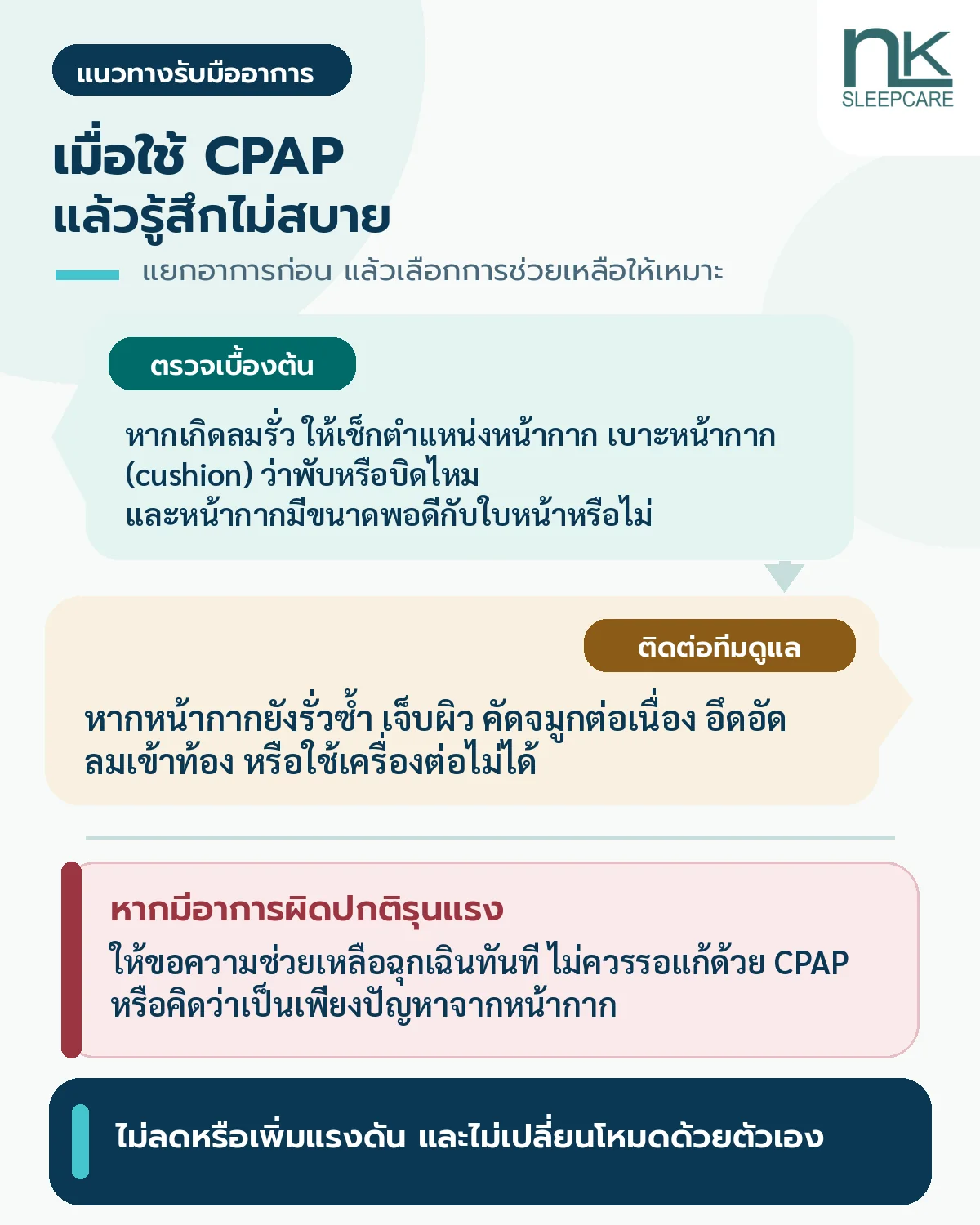
You might experience some discomfort when starting a CPAP machine, but many problems can be solved if the cause is found. Don't endure the discomfort until you eventually give up, and avoid trying to fix the problem by changing the pressure, mode, or settings yourself.
The mask is leaking or air is getting into your eyes.
First, check that the mask is in the correct position, that the mask padding is folded properly, that it's the right size, and that the equipment is still in good condition. Tightening the fasteners doesn't always help, as it may deform the padding and cause more leaks. If the problem recurs, ask the caregiver to check it while the patient is lying down, instead of trying multiple adjustments at once. [7]
Skin pain, scarring, or pressure marks.
Minor marks may appear after removing the mask, but if the skin becomes painful, persistently red, chafed, or develops a wound, avoid pressing the mask on the same spot again and contact your care team to check the mask size, strap adjustment, and type. If the wound spreads, becomes swollen, hot, develops pus, or you develop a fever, consult a doctor. [7,13]
Dry nose, dry mouth, nasal congestion, or runny nose.
These symptoms may be related to humidity, air leakage from the mouth, the mask, or a pre-existing nasal condition. A humidifier may help some users, but it needs to be set up and maintained according to the machine's system. If nasal congestion persists, nosebleeds are frequent, or you suspect allergies, you should consult a doctor to determine the cause separately. CPAP is not allergy medication, and you should not start nasal sprays or antihistamines on your own, or stop taking your regular medication on your own. [2,4,7]
Feeling pressured, difficulty breathing, or tightness in the chest.
This symptom may be due to unfamiliarity with the machine, a leaky mask, or improper machine settings. You should inform the support team when the symptom occurs so they can check the mask, the breathing assistance function, and the pressure settings. Do not adjust the pressure yourself, as similar symptoms may be caused by different factors. [7]
Bloating, belching, or gas in the stomach.
Abdominal gas can be caused by several factors, such as accidentally swallowing air, a leaking mask, sleeping position, or excessively high pressure. If this happens frequently, causes abdominal pain, or renders the device unusable, you should consult a support team to investigate the cause. Do not attempt to reduce the pressure or change modes yourself. [7]
Unconsciously removing the mask, insomnia, or feeling scared.
Trying to wear a mask while awake, starting with short intervals or switching to a different type of mask as directed, may be helpful. If you experience severe anxiety, palpitations, or difficulty breathing, remove the mask, rest in a safe place, and consult a doctor or healthcare team. Do not force yourself to continue, as this may worsen your anxiety. [7]
If you experience severe difficulty breathing, chest pain, unconsciousness, blue lips, confusion, or any other emergency, seek immediate emergency medical assistance. Do not wait to treat it with a CPAP machine at home. [14,15] For non-emergency problems that prevent continued use of the device, you should contact your doctor or the team assisting with its use as soon as possible.
How to clean a CPAP machine, and why you shouldn't use ozone or UV instead of regular cleaning.
The device, mask, tubing, filters, and humidifier should be cleaned according to the manual of your specific model, as materials, disassembly methods, water type, and maintenance frequency may vary. There is no single guideline that applies to all brands and models. [6]
The general safety guidelines are as follows:
- Turn off the appliance, unplug it, and disassemble it according to the manual before cleaning.
- Wash only the parts that the manual indicates are washable, which generally uses water and mild soap.
- Rinse off the soap residue and allow it to dry properly before reassembling.
- Do not immerse the main unit, electrical parts, or any equipment that the manual specifies as "keep dry" in water.
- Maintain or replace filters according to the type and instructions for your model. Some filters are washable, but others must be replaced.
- Use water and care for the humidifier according to the manual. Do not add fragrances, oils, or cleaning agents to the system yourself.
- If parts are cracked, discolored, sticky, have an unusual odor, or are poorly sealed, they should be inspected before further use.
The U.S. Food and Drug Administration (FDA) recommends rinsing equipment according to the manufacturer's instructions and warns that some ozone or UV light-based devices may not be approved for cleaning or sterilizing CPAP machines as advertised, due to factors such as the intended purpose, the components used, and the method of use. Ozone can expose users to dangerously high levels of gases, and both ozone and UV light can damage certain devices. [6]
Even if the supplementary equipment or service uses the word "sterilization," regular cleaning of oil, dirt, and other contaminants from the skin is still required according to the instructions. Before using ozone or UV light, three things should be checked: what the product is authorized for, which parts it is intended for, and how it should be used. Additionally, check if the CPAP manual permits its use, and note that it should not be used as a substitute for routine cleaning as per the instructions.
Before making a purchase, what should you consider besides brand and price?
Choosing a CPAP machine should start with test results and a treatment plan, not with the most advertised or feature-rich model. A machine that's right for one person may not be right for another, even if the prices are similar.
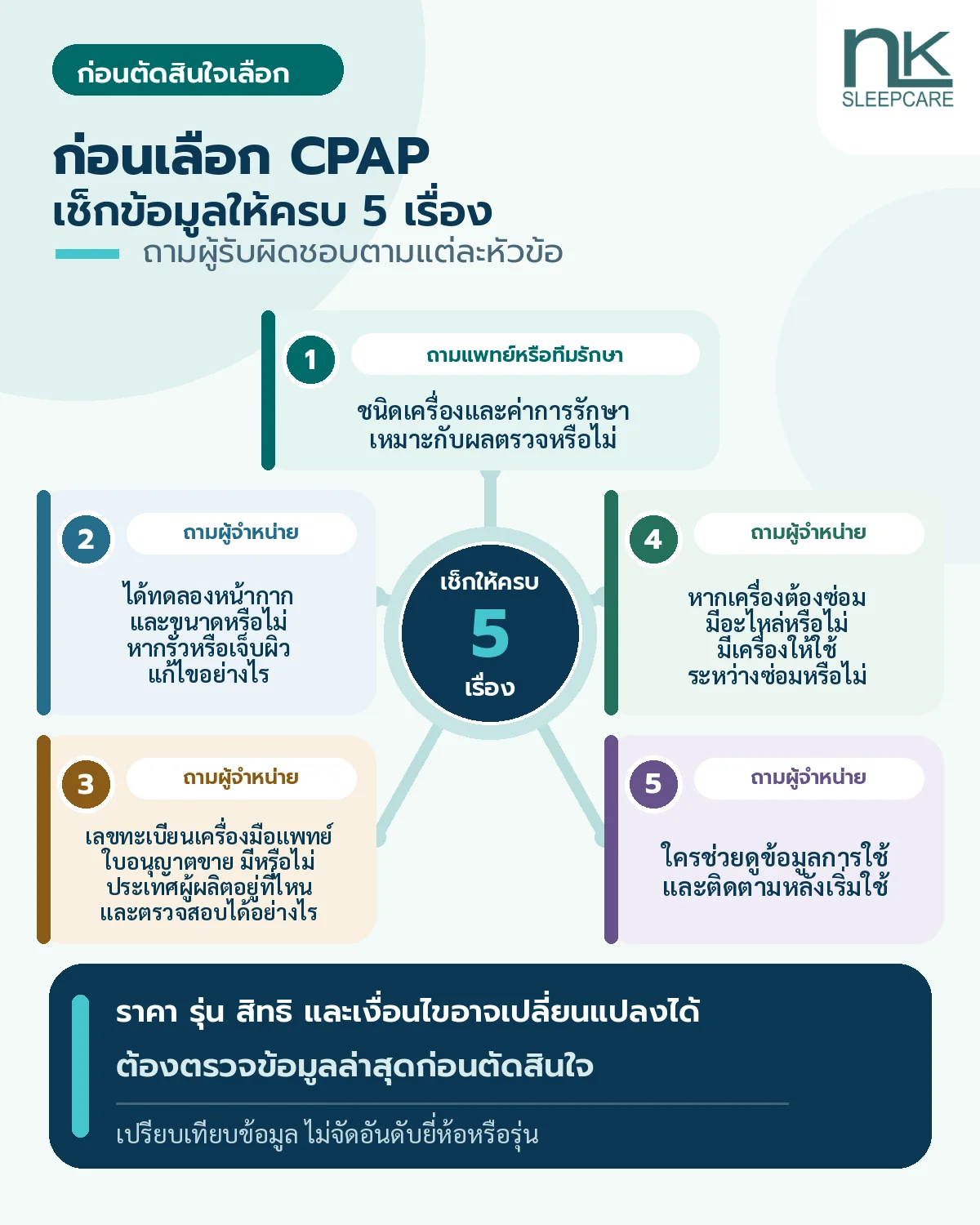
Before making a decision, be sure to ask your doctor, healthcare provider, or supplier all of the following questions.
- Are the type of device and the settings on the device compatible with the test results? Who is responsible for reviewing the data, and how will the device be set up correctly according to the doctor's instructions?
- Have you tried on the masks and sizes? If there's an air leak or pressure marks, how do I replace the mask or adjust it for a better fit?
- Do the manufacturers, importers, and distributors have all the necessary registrations or documents required by law? Where can I check the registration number, documents, and source?
- What does the warranty cover? Are the timeframe, repair procedures, costs, and exceptions clearly specified?
- Are spare parts and consumables readily available? Examples include filters, tubing, mask pads, and humidifiers.
- What are the backup plans during the repair process? Are there loan devices or guidelines available to ensure users don't miss treatments, and what are the conditions?
- Do you have access to usage data? Who can help me monitor air leakage rates, usage hours, and treatment outcomes, as well as how personal data is collected and used?
- Is there any follow-up after the actual implementation? Contact information, response times, and service scope should be clearly checked.
Pricing and benefits for CPAP machines, including documentation, available models, and warranty terms, may change. Social Security beneficiaries should check current guidelines directly with the Social Security Office or the relevant healthcare facility. [9] For current prices, available models, and warranty conditions, please confirm with the manufacturer, importer, or distributor before making a decision.
When comparing different devices, consider the pressure type, compatible masks, humidification system, noise level, size, specifications, spare parts, warranty, and after-sales service. Do not judge solely by brand name, and always request detailed service terms and conditions in writing before purchasing.
Frequently asked questions about CPAP.
How do you pronounce CPAP, and what does it stand for?
CPAP, pronounced "See-ap," stands for Continuous Positive Airway Pressure. This means that continuous positive pressure helps support the airway during sleep.
Does CPAP help everyone who snore?
No, CPAP helps reduce snoring associated with airway narrowing in suitable individuals, especially those with OSA (Obstructive Snoring). However, snoring has many causes, so people who snore normally shouldn't buy a machine and adjust the pressure themselves without first having a doctor diagnose the cause. [1,5]
Is a sleep test required before using a CPAP machine?
Before treating OSA with PAP, it's crucial to confirm the condition with a sleep study, not just rely on symptoms or snoring. The results should be reviewed by a doctor before starting treatment. The testing methods and procedures may vary depending on each individual's health. [3]
How does a CPAP machine differ from an oxygen concentrator?
CPAP machines use room air to create pressure to help open the airway, while oxygen concentrators increase the concentration of oxygen for people whom a doctor deems necessary. These two types of machines serve different functions and should not be connected together without a plan from the care team. [5]
What is the difference between CPAP and Auto CPAP?
CPAP, or Fixed CPAP, delivers a single pressure level during use, while Auto CPAP, or APAP, automatically adjusts the pressure within a set range based on breathing patterns and the machine's calculations. Automatic methods are not inherently better for everyone, and regardless of the type, appropriate settings and monitoring by a physician or healthcare team are necessary. [2,5]
Once you start using a CPAP machine, do you have to use it for life?
The duration depends on the cause, as well as changes in health, weight, and airway structure.
CPAP helps control obstruction during use. If you need to stop using it due to weight changes, surgery, or other treatments, you should have your doctor evaluate and monitor your condition as appropriate. Do not stop on your own simply because you feel better or your snoring has quieted down. [4]
How many hours should a CPAP machine be used at least?
If possible, you should wear the CPAP machine every time you sleep, including during naps, and continue wearing it until you wake up. The 4-hour figure is often used in research, and the Social Security Office uses this figure as part of its reimbursement criteria, but it doesn't mean that this amount is sufficient for everyone. CPAP is only effective when the machine is worn and turned on. For other insurance coverages, please check the conditions directly with your insurance provider. [2,9]
What should you do if you feel uncomfortable, have air leaks, or have dry mouth?
The mask placement and size, tube condition, humidity, and leak data should be checked.Contact the support team.To find the cause, even if you suspect the voltage is unsuitable, you should not adjust the mode or settings yourself. [4,7]
Is it okay to bring a CPAP machine on an airplane?
It depends on the airline, route, and country's regulations. However, just because you can bring a CPAP machine on board doesn't mean you can always use it during the flight. Therefore, before traveling, you should check directly with the airline operating your flight regarding CPAP machine allowances, usage during the flight, battery availability, power supply, and water for the humidifier. [10,11,12]
Summary and next steps that are right for you.
A CPAP machine creates positive pressure from room air to help support the airway during sleep. It's commonly used to treat adults diagnosed with OSA (Obstructive Sleep Apnea). It's not an oxygen concentrator, it generally doesn't replace the user's breathing, and it's not a snoring solution that everyone should buy and use on their own. [1,5]
If you haven't had a sleep test yet but snore loudly regularly, have been seen stopping breathing, suddenly gasping for breath, experience excessive daytime sleepiness, feel unrested upon waking, or pose a risk while driving, you should see a doctor for an evaluation and to discuss a sleep test before choosing a device. If drowsiness poses a risk of accident, you should avoid driving and seek medical advice as soon as possible. [3,4]
Once obstructive sleep apnea (OSA) is confirmed, before choosing a CPAP or PAP machine, you should discuss the test results and prescription or instructions with your doctor regarding the type of machine, pressure levels, mask, monitoring methods, and post-treatment support. Do not start, change, or stop your OSA treatment plan on your own. [1,3]
Patients who are using a CPAP or PAP machine and experience air leakage, discomfort, dry mouth, bloating, or remove their mask in the middle of the night should not stop treatment or adjust the pressure on their own. They should...Ask for help early on. To allow the care team to check your mask, humidity, equipment, settings, and personal health, if you experience severe difficulty breathing, chest pain, unconsciousness, blue lips, confusion, or any other emergency, you should seek emergency assistance immediately and not wait to resolve the issue with CPAP at home. [7,14,15]
This information is for general informational purposes only and does not replace a medical diagnosis or advice. If you suspect you have sleep apnea, consult a doctor or sleep specialist. Seek immediate medical attention in case of an emergency.
References
- Patil SP, et al. Treatment of Adult Obstructive Sleep Apnea with Positive Airway Pressure: An American Academy of Sleep Medicine Clinical Practice Guideline. Journal of Clinical Sleep Medicine. 2019.
- Patil SP, et al. Treatment of Adult Obstructive Sleep Apnea With Positive Airway Pressure: An American Academy of Sleep Medicine Systematic Review, Meta-Analysis, and GRADE Assessment. Journal of Clinical Sleep Medicine. 2019.
- Kapur VK, et al. Clinical Practice Guideline for Diagnostic Testing for Adult Obstructive Sleep Apnea. Journal of Clinical Sleep Medicine. 2017.
- National Institute for Health and Care Excellence. Obstructive sleep apnoea/hypopnoea syndrome and obesity hypoventilation syndrome in over 16s (NG202).
- American Thoracic Society. Positive Airway Pressure (CPAP and BPAP) for Adults with Obstructive Sleep Apnea.
- US Food and Drug Administration. Do You Need a Device That Claims to Clean a CPAP Machine?
- American Academy of Sleep Medicine. Frequently Asked Questions for PAP Troubleshooting.
- Bhat S, et al. The Efficacy of a Chinstrap in Treating Sleep Disordered Breathing and Snoring. Journal of Clinical Sleep Medicine. 2014.
- Social Security Office. Announcement of the Medical Committee under the Social Security Act regarding the criteria and rates for compensation benefits in cases of injury or illness not resulting from work, specifically for sleep apnea, dated July 13, 2026, effective July 30, 2026.
- US Transportation Security Administration. Nebulizers, CPAPs, BiPAPs, and APAPs.
- US Federal Aviation Administration. Airline Passengers and Batteries.
- Electronic Code of Federal Regulations. 14 CFR § 382.133: Evaluation and use of passenger-supplied electronic respiratory assistive devices in flight.
- MedlinePlus. How to care for pressure sores.
- MedlinePlus. Recognizing medical emergencies.
- MedlinePlus. Blue discoloration of the skin.