
Is a CPAP machine covered by social security? Summary of rights and procedures for 2026.
Last updated:
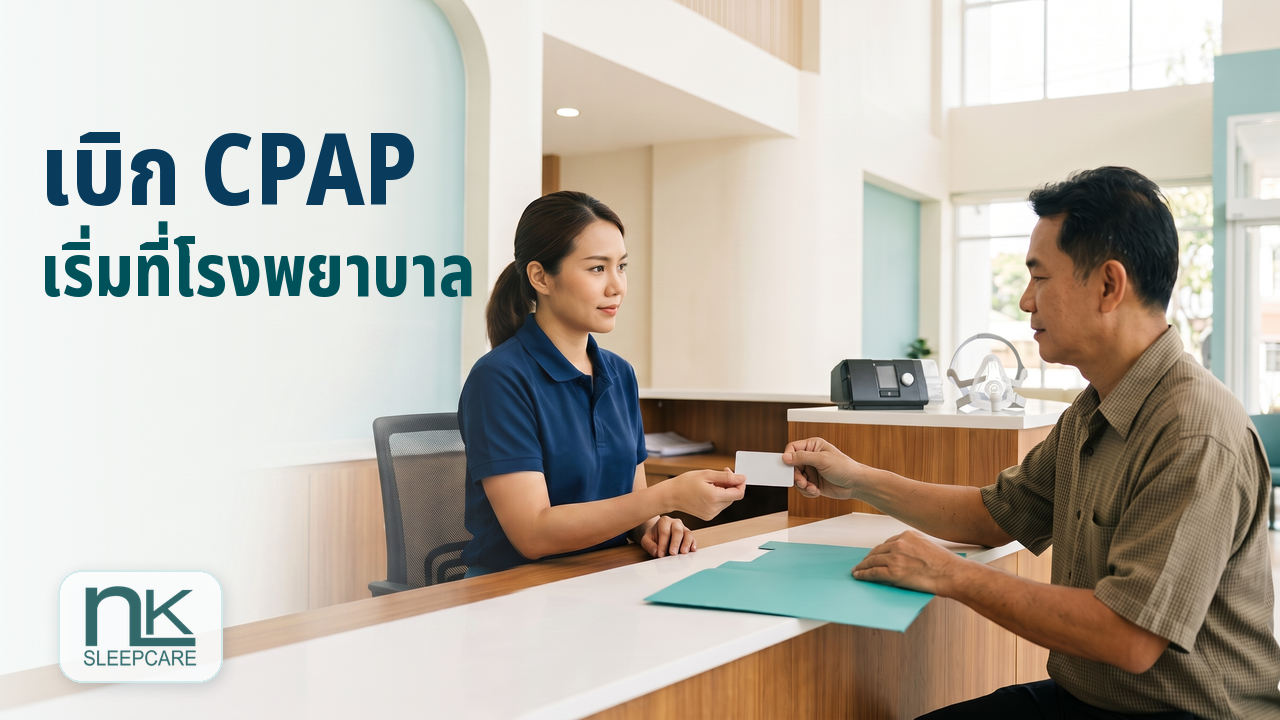
It can be reimbursed, but the process must be done through the hospital according to your insurance coverage. It's not a matter of buying the device first and then submitting the receipt for reimbursement, or using the 20,000 baht credit limit as a discount at general stores. Insured individuals must undergo an assessment, a sleep study, meet medical criteria, and try the device according to the announcement effective from July 30, 2026.2
Quick summary: What does social security pay for, and where to start?
- Who is eligible to vote? Insured persons under Section 33 and Section 39 who are still active in their coverage and have contributed for at least 3 months within the 15 months prior to the month of receiving services, and who also meet the medical criteria.56
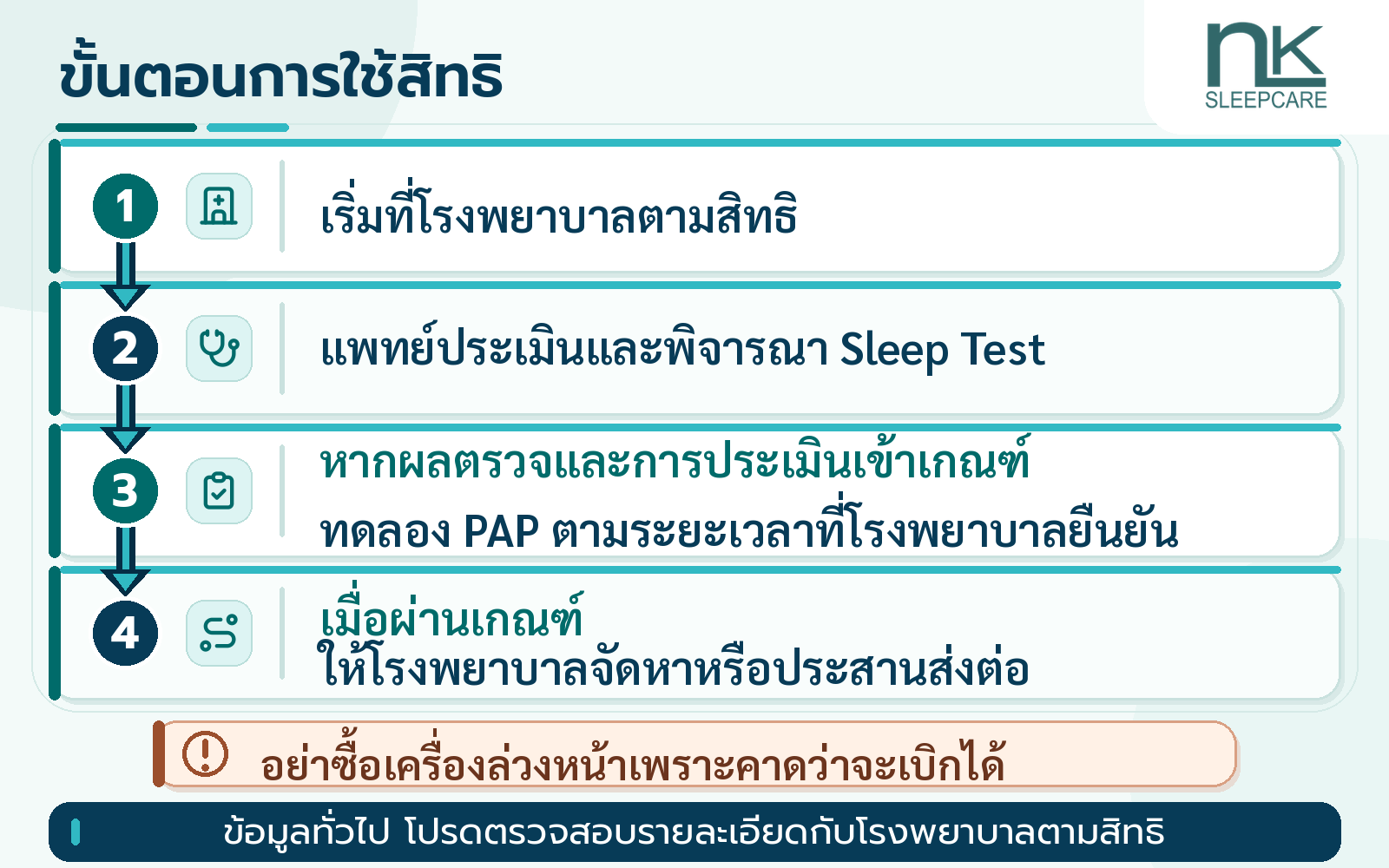
- Where to start: Go to the hospital under your insurance plan for a doctor to assess your condition and plan further examinations or referrals.2
- Sleep Test: Type 1: Monitoring by an officer throughout the inspection; reimbursement based on actual expenses, not exceeding [amount]. 7,000 baht Type 2 involves the same measurements as Type 1, but without monitoring by staff, and payment is based on actual costs, not exceeding a certain limit. 6,000 baht.2
- PAP machine: Payment is made within the hospital process. 20,000 baht per set The kit includes the device, mask, connecting tubing, and related accessories, ready for use.2
- PAP mask: Rate 4,000 baht per piece The conditions for claiming replacement masks from the second time onwards are explained separately in the section below.2
Individuals insured under Section 40 who use their existing healthcare entitlements, such as the National Health Security Scheme or the Gold Card scheme, should not consider the PAP benefits mentioned in this article as part of their Section 40 healthcare coverage.7
Don't buy equipment in advance just because you expect to be able to claim reimbursement. The announcement designates hospitals under the insurance scheme as responsible for diagnosing and procuring equipment, or referring patients when their capabilities are exceeded.2
Criteria for receiving PAP/CPAP machines and masks.
The word PAP The new regulations cover single-level, two-level, or automatic positive pressure air (CPAP) machines, subject to specified specifications. CPAP is a commonly used term. The requirements below must be met through a hospital under your insurance coverage; purchasing the machine or mask first and then claiming reimbursement is not permitted.2
Criteria for receiving your first PAP/CPAP machine.
Receiving your first PAP/CPAP machine isn't based solely on the AHI value; the following conditions must also be met.2
- The doctor assessed that conservative treatment was ineffective, or that the problem could not be solved with uncomplicated surgery, or that surgery was ineffective.
- There are sleep study results and a report available.
- It meets one of the following categories of severity.
- AHI ≥30 times per hour or
- AHI 15–29 times per hour And have at least one of the following conditions: stroke, myocardial infarction, heart failure, or refractory hypertension of 140/90 mmHg or higher while taking at least three classes of antihypertensive medications.
- Try using PAP at least. 1 or 2 weeks Hospitals are required to confirm the duration prior to the start of the trial, and to provide reports of at least an average usage period. 4 hours per night, calculated cumulatively for all nights during the trial period.
The announcement does not specify whether a one-week or two-week trial period is required for certain cases, so it is advisable to confirm the duration and reporting format with the hospital before beginning the trial.2
AHI (Acute Health-Based Isolation) is the average number of breathing pauses or shallow breathing events per hour recorded during a sleep study. This figure must be interpreted by a doctor in conjunction with other test results and overall health; it should not be used for self-diagnosis or to make independent decisions.2
Criteria for receiving the next PAP/CPAP machine (from the second time onwards).
According to the new regulations of 2026, applicants for subsequent PAP/CPAP machines must apply through a hospital under their insurance coverage and meet the current criteria as follows:.2
- There is evidence that the original machine was faulty.2
- Try out the new device for at least 4 weeks.2
- The new machine was reported to be used for an average of at least 4 hours per night, calculated over all nights during the trial period.2
A new regulation in 2026 does not specify a 5-year waiting period for the next PAP/CPAP machine.2
The original announcement from 2024 stipulated that for the second use onwards, the device must be damaged and irreparable, with confirmation from the supplier that replacements are possible every 5 years, and evidence of average daily use of at least 4 hours, totaling at least 701 TP3T, for a period of at least 3 months, was required. Those who previously received benefits under the original announcement should have their status checked by the hospital on a case-by-case basis.23
Criteria for receiving replacement PAP masks from the second time onwards.
Please contact your designated hospital to request a replacement PAP mask from the second use onwards. The current criteria are as follows:.2
- The mask is damaged or unusable.2
- You can claim a maximum of 1 item per year.2
- There is evidence of average use of the machine for at least 4 hours per day, with no less than 70% of total daily use, over a period of at least 3 months.2
These three conditions were already in the 2024 announcement and were not just introduced in 2026.23
How to claim social security benefits for PAP/CPAP machines.
- Check your insured status and the hospital you are entitled to. Check if your status is still active and the hospital name is correct according to your insurance coverage. If unsure, contact SSO 1506.56
- See a doctor at the hospital under your insurance coverage. Report symptoms such as snoring, someone noticing pauses in breathing, sudden breathing changes, or unusual daytime sleepiness.
- Receive a pre-evaluation before submission for testing. The physician will take a medical history, perform a physical examination, and consider the STOP-Bang score, or have a sleep medicine specialist review cases that fall outside the criteria.2
- Sleep study The hospital will assess whether it's suitable for type 1 or type 2 and may refer the patient if it exceeds their capabilities.2
- Have your doctor assess your eligibility for PAP. Based on the AHI test results, comorbidities, past treatments, and suitability of the device.2
- Try it out and save the report. According to the timeframe confirmed by the hospital before the trial began.2
- Please wait for the hospital to inform you on how to receive the device. If the hospital under your insurance coverage is unable to provide the service due to exceeding its capacity, it will refer you to a more capable or qualified medical facility as per the announcement. This referral does not mean that insured individuals should purchase the equipment from stores themselves. The announcement stipulates that hospitals must procure equipment and masks within one month, but it does not specify the starting date of the event. Therefore, you should ask the hospital about the specific date the timeframe begins.2
What information should I prepare to take to the hospital?
The following is a guideline for preparation; it is not a standardized list of documents that all hospitals are required to follow.
- Please provide your national ID card and the name of the hospital you are entitled to. If you are unsure which hospital, please contact SSO 1506.
- Sleep test results or original medical certificate, if available.
- List of pre-existing medical conditions and medications currently being used.
- Report on the use of your existing device and information about any problems with the device or mask, if you are already using it.
- Questions regarding machine type, excess costs, warranty, and post-delivery responsibilities.
What brand of CPAP machine can I get, and can I choose the machine myself?
The announcement does not specify any brand or guarantee that insured individuals can choose any model of device they wish, but it does define the relevant features and responsibilities as follows:.2
- The hospital must provide equipment with a warranty for at least... 5 years And they are responsible for repairing or replacing the machine if it is damaged.2
- The machine must pass quality certification from... Food and Drug Administration (FDA).2
- It is a positive pressure (PAP) machine. 1 level, 2 levels, or automatic..2
- The machine must calculate and record usage as a percentage of the average number of days used, at least. 4 hours a day Continuously for at least... 1 year.2
- The distributing company must have a system for monitoring results and educating users.PAP Education).2
Although the announcement mentions excess charges when it's a patient's request, it doesn't make it a general right to purchase from any store and then claim reimbursement or deduction later.2
How have the criteria for 2026 changed from the previous ones?
Compare the criteria for 2024 and 2026.
| case | Original criteria in 2024. | New criteria for 2026. |
|---|---|---|
| The first PAP/CPAP machine | AHI >15 or AHI 5–15 combined with cardiovascular disease, hypertension, or stroke.3 | AHI ≥30 or AHI 15–29 combined with stroke, myocardial infarction, heart failure, or treatment-resistant hypertension, and try the trial for 1 or 2 weeks as confirmed by the hospital.2 |
| The next PAP/CPAP machine | The original machine is damaged and irreparable. The supplier confirms that it can be replaced every 5 years, and there is evidence that the machine was used for an average of at least 4 hours per day, totaling at least 701 TP3T per day, over a period of at least 3 months.3 | There is evidence that the original machine was faulty, and a new machine was tested for an average of at least 4 hours per night, calculated every night for a trial period of at least 4 weeks, without specifying a 5-year waiting period.2 |
| Replacement PAP masks are available from the second use onwards. | A subsidy of 4,000 baht is provided for defective or unusable equipment, with a maximum of one item damaged or unusable per year, and evidence of average daily use of the machine for at least 4 hours, totaling at least 701 TP3T per day over a period of at least 3 months.3 | The rate is 4,000 baht. The item must be damaged or unusable. Reimbursement is limited to one item per year. Proof of average daily use of the device is required, with at least 4 hours of use per day and a total of at least 701 TP3T (multi-purpose unit) used daily for a period of at least 3 months. These three conditions were already in the 2024 announcement and were not just introduced in 2026.23 |
Questions you should ask the hospital before receiving the device or paying for it.
- We need to test the first device for one or two weeks, and what report format should we use?
- Does the hospital provide it itself or refer it to somewhere else? And from what date does the "within 1 month" period begin?
- What types, brands, and models of PAP machines are on the procurement list, and which model is suitable for the doctor's prescription?
- If additional features are required, what are the extra costs, and to which agency are the payments made?
- Who is responsible for training, follow-up, warranty, repair, replacement, and loaner equipment during repairs?
FAQ
If I only snore, can I claim for a CPAP machine?
It's still inconclusive. Snoring is not necessarily a reason to see a doctor, but receiving a sleep study requires a assessment of the severity of the snoring, past treatments, trial use of PAP (Paper Action Plan), and hospital procedures.2
Is a sleep test reimbursable through social security?
This is possible if the doctor and hospital under the insurance scheme deem it necessary. Social Security sets the rate at no more than 7,000 baht for Type 1 and no more than 6,000 baht for Type 2. The eligibility for the test is separate from the conditions for receiving a PAP machine.2
Does Article 39 grant the right to do so?
Yes, insured persons under Section 39 must have an active status and have contributed for at least 3 months within the 15 months prior to the month of receiving the service. Then, the process begins at the hospital under their coverage, where a doctor will assess their condition, conduct a sleep study, and determine if they meet the criteria for receiving a PAP machine according to the announcement.256
Can I buy the equipment myself first and then claim 20,000 baht?
The announcement does not endorse self-purchase and reimbursement schemes, or the use of the 20,000 baht general discount. Hospitals must confirm the procurement, model, and payment method beforehand.2
Can I change my mask every year?
This is not an automatic entitlement. Subsequent masks must be damaged or unusable. A maximum of one mask per year is allowed, and proof of PAP usage meeting the criteria is required.2
summarize
CPAP/PAP machines are covered by social security for eligible individuals. Check your insurance status and the hospital you are entitled to. See a doctor and undergo a sleep study. If you meet the criteria, try a PAP trial for the period confirmed by the hospital and wait for the hospital to inform you of the method of receiving the device before paying or choosing a device..256
This article provides general information from the announcement and does not replace a personalized diagnosis or advice from a physician. Details regarding documentation, referrals, waiting times, and device models may vary by hospital.


