Sleep Test under Social Security: Rights and Procedures according to the new criteria in 2026.
Last updated:
If you are insured and suspect you have sleep apnea, you may be able to use your insurance to get a sleep test, once your doctor determines that you meet the criteria. The easiest way to check your eligibility is to start by contacting the healthcare facility that covers your insurance coverage. That's the medical facility you've chosen through social security.
The Social Security Office (SSO) has issued the current announcement dated... July 13, 2026 Effective from [date]. July 30, 2026 The proposed rates for Type 1 testing are capped at 7,000 baht (actual cost) and Type 2 testing at 6,000 baht (actual cost), along with clearer guidelines for pre-test assessment.[1]
Things to do first: Contact your designated healthcare facility, report your symptoms, and have a doctor assess your condition before your next appointment. If you are unsure which healthcare facility you are entitled to, or have specific questions, contact the Social Security Office or call the hotline at 1506.[5]
Is a sleep test reimbursable under social security?
The easiest way to check is to contact your healthcare provider and have a doctor assess whether there is a medical reason to order the test.
For insured persons under Sections 33 and 39, the benefits page of the Social Security Office states that when receiving treatment at a medical facility under their entitlement, insured persons do not have to pay any expenses.[3]
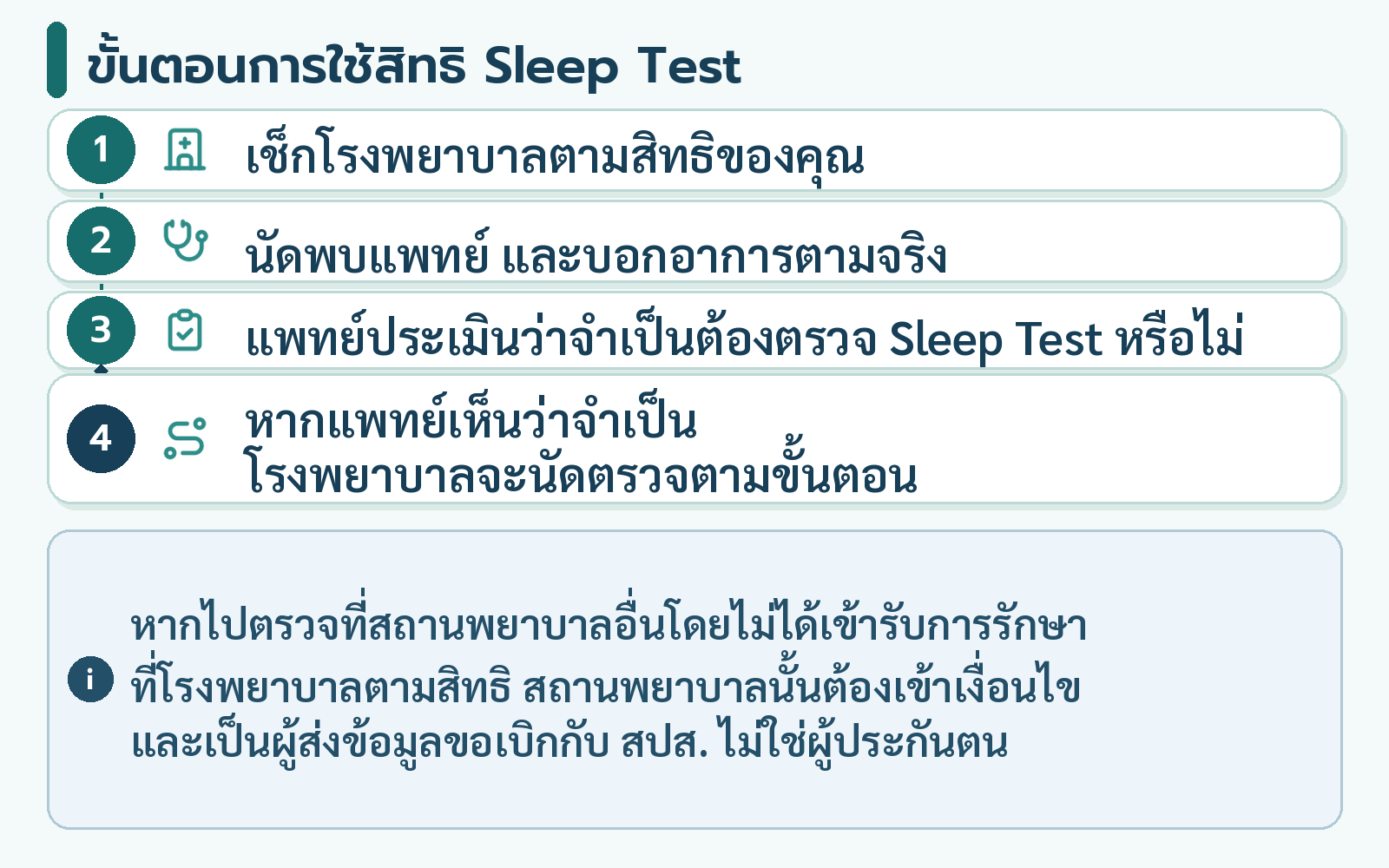
If you do not receive treatment at your designated medical facility, you can still use services at another medical facility, but that facility must meet all three conditions: 1) It must be able to diagnose and treat sleep apnea; 2) It must be certified by a relevant royal college or professional association; and 3) It must be registered with the Social Security Office for this type of service. The medical facility will then submit the reimbursement request to the Social Security Office. If the service fee exceeds the specified rate, the insured person will only be responsible for the excess amount.[1]
However, the term "reimbursable" does not mean:
- ❌ All insured persons can request a check immediately.
- ❌ You can choose to get tested at any hospital or clinic.
- ❌ You can always pay upfront and then claim reimbursement with the receipt.
- ❌ If you pass the test, you will receive a PAP device immediately.
- ❌ There will be no extra charges whatsoever.
Therefore, before receiving the service, you should clearly ask whether the test is covered by social security benefits and whether there are any additional services or extras that you have to pay for yourself.
Who is eligible to claim reimbursement?
Insured persons are divided into several sections, as follows:
- Article 33: Employees who are still employed by the employer and contribute through the establishment.[6]
- Article 39: Individuals who were previously insured under Section 33 and have left their jobs, but have applied to continue contributing to the social security fund on their own.[6]
- Article 40: Self-employed individuals who register for social security themselves.[7] This group receives medical treatment using the universal healthcare card or their existing healthcare entitlement, and are not using the same healthcare entitlements as those under Sections 33 and 39.[4]
For Articles 33 and 39, the general condition for illness benefits is that contributions must have been made for at least 3 months within the 15 months prior to the month of receiving the service.[3] Before your appointment, please check if you are still insured and where your designated medical facility is located. If you are unsure, please call the hotline 1506.
Check for initial symptoms yourself.
You should consult a doctor if you have symptoms or factors that suggest you may have sleep apnea, such as:
- I snore loudly regularly.
- Some people have reported that they stop breathing or gasp for breath during sleep.
- Feeling unusually sleepy during the day.
- Woke up feeling unrested.
- There may be other diseases or health factors that the doctor deems should be evaluated simultaneously.[2]
This information is intended to help you prepare before talking to your doctor. It is not a diagnostic criterion and does not guarantee that you are eligible for a sleep test.[2]
Pre-examination criteria according to the new announcement.
The announcement, effective July 30, 2026, outlines pre-test guidelines stating that physicians must take a medical history, perform a physical examination, and assess the risk using a risk score. STOP-Bang: 5 points or moreThis is considered one of the important criteria.[1]
If the score falls below the required threshold, a sleep physician may still consider ordering further tests if deemed medically necessary.[1]
You can try taking the STOP-Bang test yourself, but the results are only a preliminary assessment and cannot replace a doctor's diagnosis.[2] Therefore, this result should not be used to determine eligibility or conclude that "the score is below 5, so verification is definitely not possible."“
Things to prepare for your doctor's visit.
- Details of the symptoms and their duration.
- Information from close friends or family members who observed your symptoms while you slept.
- List of pre-existing medical conditions and medications currently being used.
- Previous test results or medical records, if available.
- Questions regarding hospital procedures, waiting lists, and costs.
How much is reimbursable for a sleep test?
The announcement outlines the inspection schedule as follows:[1]
- Sleep Test Type 1: There are officers monitoring throughout the night during the inspection. Payment is based on actual expenses, not exceeding the limit. 7,000 baht
- Sleep Test Type 2: The measurements are the same as for type 1, but there is no officer monitoring during the inspection. Payment is based on actual costs, not exceeding the limit. 6,000 baht
The term "reimbursement of actual costs" refers to the rate set by the Social Security Office for services as per the announcement, and does not include cash or personal funds that insured persons can use to purchase services anywhere.
Doctors and medical facilities should be allowed to choose the type of test based on medical reasons and hospital procedures, not solely on price.
Caution: The phrase "no staff member will be present during the examination" does not mean that all insured individuals have the right to take the equipment home for testing. If the hospital schedules an examination outside the sleep study room or allows you to take equipment home, you should ask directly what type of examination it is under social security coverage and whether there is any out-of-pocket expense.[1]
Steps to claim your Social Security Sleep Test benefit.
1. Check the healthcare facility covered by your insurance.
Start with the medical facility you've chosen through your social security insurance. If you're unsure, check with the Social Security Office or call 1506.
2. Schedule an appointment with a doctor and describe your symptoms truthfully.
Tell your doctor about your symptoms, how often they occur, how long they have lasted, any underlying medical conditions you have, and what close friends or family have noticed. Your doctor may use the STOP-Bang method in conjunction with your medical history and physical examination.[1]
3. Have a doctor assess whether further testing is necessary.
If the criteria are met or a sleep medicine physician deems it necessary, the physician will consider referring the patient for testing according to the medical facility's procedures.[1]
4. Inquire about the type of test and the testing location.
I want to know what type of test it is, what preparations are needed, whether the test will be done at a healthcare facility covered by my insurance or if I will be referred elsewhere, and whether there are any costs I have to pay myself.
5. Undergo check-ups and follow-up with your doctor.
After the test, you should schedule a follow-up appointment with your doctor to discuss the results. A diagnosis requires a comprehensive approach, including a complete sleep assessment, test results, and appropriate follow-up. You shouldn't just rely on a screening tool or a single numerical value and conclude whether or not you have a condition.[2]
If I already have a sleep test result from a private clinic, can I use it?
It's not yet possible to say definitively that it works everywhere or in every case.
The announcement does not provide a one-size-fits-all answer. Therefore, it is advisable to take the full report and documents from your previous healthcare provider to your current provider for evaluation. Then, ask the hospital directly about the criteria they will use to reconsider the original results, what documents are required, and whether a new test is necessary.
Things you shouldn't do: Paying for the test yourself with the expectation that you'll definitely be able to claim reimbursement later, the safest approach is to inquire with the healthcare facility you are covered by insurance first.
If the test results meet the criteria, will I receive a PAP device immediately?
You won't receive it immediately because the Sleep Test and the PAP device are separate processes.
After the doctor interprets the results, a further assessment is needed to determine if the individual meets the criteria for receiving a PAP machine.[1] Read more details about AHI and the device pickup process here. CPAP/PAP Machine Reimbursement Guide for Social Security
Those who were approved for PAP devices, masks, or both under the previous announcement before the new criteria came into effect will continue to receive those benefits until they have fully utilized them.[1] In this case, please provide the approval document to the healthcare facility for verification. For further details, please refer to the PAP manual above or contact the hotline 1506.
Costs should be inquired about at the hospital before the test.
| case | Who coordinates or submits the disbursement request? | Expenses as specified by the Social Security Office. | Things to ask before an appointment. |
|---|---|---|---|
| Use your benefits through the healthcare facility you are entitled to. | Medical facilities covered by insurance. | The Social Security Office's benefits page states that insured persons under Sections 33 and 39 do not have to pay any fees.[3] | It's important to ask clearly whether all appointments and services offered by the hospital are included in your insurance coverage, and whether there are any additional services or items not covered by the insurance. |
| The designated medical facility referred the patient to another medical facility. | The designated healthcare facility will coordinate and pay the referral fee to the receiving healthcare facility and claim reimbursement from the Social Security Office (SSO) according to the established criteria. | The announcement did not specify whether insured individuals would have to pay extra.[1] | You should check with the healthcare facility you are covered by before confirming your appointment. |
| Going to another medical facility instead of receiving treatment at the facility designated under your insurance. | The healthcare facility where the services were received is the one that submits the reimbursement request to the Social Security Office. | If the service fee exceeds the specified rate, the insured person is only responsible for the amount exceeding that rate.[1] | You should make sure that the medical facility meets all the specified conditions, which are:
Offering a Sleep Test service alone does not mean the medical facility accepts social security insurance. In this case, the insured person does not have to pay the entire cost themselves and then submit the receipt for reimbursement later.[1] |
What questions should I ask before confirming an appointment?
- Is this test covered by social security?
- Is this a Type 1 or Type 2 Sleep Test?
- Get tested at a healthcare facility under your insurance coverage or be referred.
- Are there any services outside of the coverage or as additional options?
- If there is an excess amount, how much do I have to pay and what is it for?
- Do I need to pay upfront? And if so, what kind of payment proof should I request from the hospital?
- If I have test results from another institution, will the hospital consider them?
- How long is the waiting time for testing and results now?
FAQ
Does social security provide free sleep tests?
For insured persons under Sections 33 and 39 who receive services through a medical facility according to their entitlements, the benefits page of the Social Security Office states that there are no charges.[3] However, the hospital must confirm beforehand that the appointment is eligible for insurance coverage and that there are no out-of-private or supplementary services offered. In cases where patients seek services at another medical facility instead of the one designated under their insurance plan, the insured person must pay the amount exceeding the announced rate.[1]
The rates of 7,000 and 6,000 baht are the announced ceiling rates. This does not mean that insured persons must pay the difference in every case. The announcement clearly states that insured persons are responsible for the amount exceeding the rate in only one case: going for a check-up at another medical facility instead of receiving treatment at the facility designated under their insurance.[1] Regarding cases where the designated medical facility refers the patient for examination at another facility, the announcement does not specify whether the insured person must pay extra. Therefore, it is advisable to check with the designated medical facility before confirming the appointment.
Can I take a sleep test without seeing a doctor?
No. If you wish to undergo a Sleep Test using your insurance coverage as per the regulations, you must first have a medical history taking, physical examination, and evaluation by a doctor.[1]
Does STOP-Bang disqualify me if I don't spend at least 5 baht?
Don't assume you're out of luck. Sleep physicians may still recommend the test if they deem it medically necessary.[1]
Which hospitals accept sleep tests under the social security scheme, and can I claim reimbursement retroactively?
Start by contacting your designated healthcare facility and ask if the hospital will conduct the examination itself or refer you to another facility. Do not book and pay for the examination yourself with the expectation of claiming reimbursement later, as the regulations do not specify that insured individuals can self-submit receipts. If you are not receiving treatment at your designated facility and wish to seek treatment at another facility, that facility must meet all three conditions: 1) It must be able to diagnose and treat sleep apnea; 2) It must be accredited by a relevant professional college or association; and 3) It must be registered with the Social Security Office (SSO) for this type of service. The facility will then submit the reimbursement request to the SSO. If the cost exceeds the specified rate, the insured individual will only be responsible for the excess amount.[1]
Can I choose either Sleep Test Type 1 or Type 2 myself?
Doctors and medical facilities should be allowed to choose the type of test based on medical reasons, not solely on price, convenience, or advertising claims.
How long do I have to wait in line?
A fixed waiting time cannot be given. Queueing depends on the medical facility, the availability of examination rooms, and referral routes. You should inquire about the waiting time with the hospital when making an appointment.
If I already have a test result, do I need to get tested again?
Depending on the assessment by the healthcare facility under your insurance coverage, you should have the full report reviewed by your doctor before drawing any conclusions about whether the original results are valid or invalid.
summarize
Under the new Social Security Sleep Test eligibility criteria, it doesn't mean you can simply choose your own test package and submit the receipt for reimbursement. The easiest way to check is...Contact the healthcare facility you are covered by and have a doctor evaluate you first.[1]
If treatment is not sought at a healthcare facility designated under the insurance plan, the other healthcare facility must meet all three criteria: be capable of diagnosing and treating sleep apnea, be certified by a relevant professional college or association, and be registered with the Social Security Office (SSO). For this type of service, the healthcare facility will submit the reimbursement request to the SSO. If the service fee exceeds the specified rate, the insured person will only be responsible for the excess amount.[1]
The announced rates, effective from July 30, 2026, are: Type 1, reimbursement of actual expenses up to 7,000 baht, and Type 2, reimbursement of actual expenses up to 6,000 baht.[1]
The safest approach is to prepare information about your symptoms, contact your designated healthcare facility, inquire about costs before receiving services, and avoid making upfront payments with the assumption that you will be able to claim reimbursement later. In specific cases or if you receive conflicting information, verify your details with the Social Security Office or their hotline at 1506.
References
[1] Social Security Office. Announcement of guidelines and rates for insured persons with sleep apnea. Dated July 13, 2026, effective July 30, 2026 (accessed August 11, 2026).
[2] Kapur VK, Auckley DH, Chowdhuri S, et al. Clinical Practice Guideline for Diagnostic Testing for Adult Obstructive Sleep Apnea. Journal of Clinical Sleep Medicine. 2017;13(3):479–504. American Academy of Sleep Medicine (accessed August 11, 2026).
[3] Social Security Office. Benefits in case of injury or illness not related to work. Conditions for entitlement and receipt of services at healthcare facilities under the entitlement scheme (Accessed August 11, 2026).
[4] Social Security Office. Benefits and conditions for eligibility to receive compensation under Section 40. Indicate whether the healthcare entitlement uses the universal health coverage scheme, the gold card scheme, or existing entitlements (accessed August 11, 2026).
[5] Social Security Office. Contact information Contact number 1506 (Accessed August 11, 2026)
[6] Ministry of Labour. Rights of insured persons under Sections 33 and 39. It states that Section 33 applies to employees, and those who have ceased to be employees may apply to be insured under Section 39 under certain conditions (Accessed August 11, 2026).
[7] Ministry of Labour. Guidelines and conditions for insured persons under Section 40. It explains that Section 40 refers to independently insured persons who are not employees under Section 33 or insured persons under Section 39 (Accessed August 11, 2026).