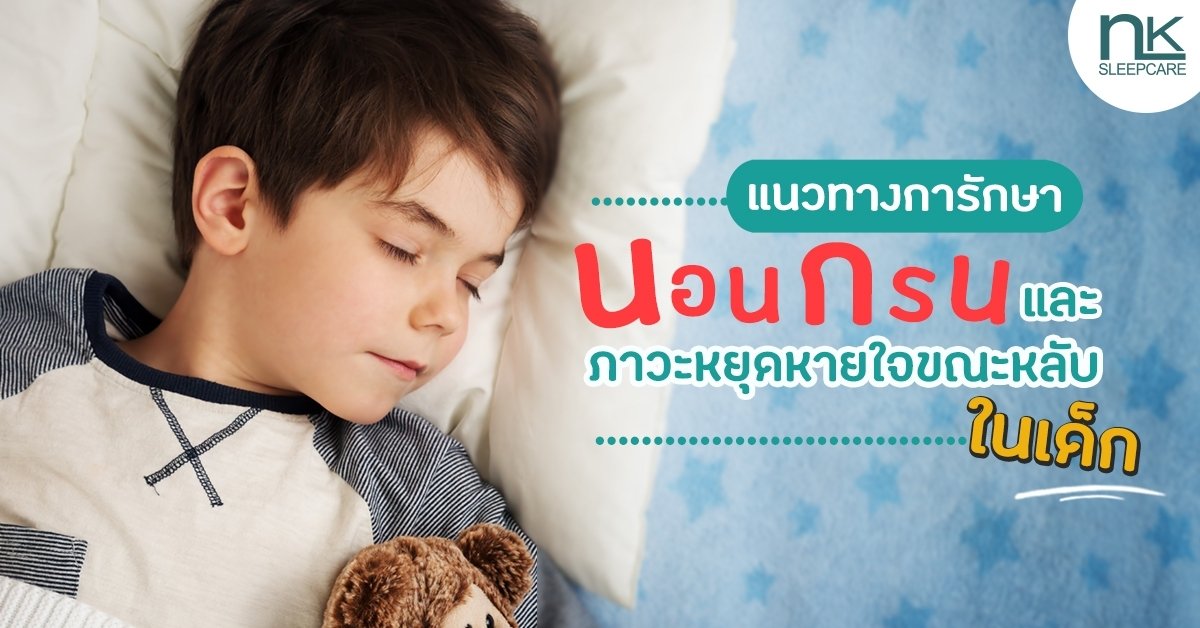
Guidelines for the treatment of snoring and sleep apnea in children.
Children who snoreFrom 3 nights or more per week, and especially in cases with certain abnormalities such as failure to thrive, behavioral problems, poor academic performance, bedwetting, etc., a diagnosis should be made. Obstructive sleep apnea (Obstructive sleep apnea; OSA) or not, in order to proceed with treatment.
Initially, children who snore should avoid cigarette smoke, pollution, and allergens, as these can cause nasal congestion and worsen symptoms. Overweight children should lose weight, and those with bacterial infections in the upper respiratory tract should be given antibiotics. However, there are currently several highly effective treatment methods for children with this problem, including:
1. Surgical treatment: Removal of tonsils and adenoids.
This is the most effective treatment. Generally, this surgery significantly improves the symptoms of obstructive sleep apnea (OSA) and reduces the number of apnea episodes (hypopnea) by approximately 85-90%.
However, some high-risk groups of patients, such as children with severe sleep apnea, obese children, facial abnormalities, or neuromuscular disorders, children with Down syndrome, deviated nasal septum, and severe nasal mucosal edema, may have residual sleep apnea after surgery. Therefore, monitoring these patients is especially necessary.
Tonsillectomy and adenoidectomy are performed under general anesthesia and generally carry a very low risk of serious complications. However, for the first 1-2 weeks after surgery, monitoring is necessary for bleeding from the surgical site, nausea and vomiting, dehydration (which may occur due to pain and reduced food intake in some cases), and occasional difficulty breathing and snoring for the first 2-3 days.
Therefore, patients should be hospitalized in a well-equipped hospital for at least 1-2 days, where doctors will provide appropriate care to prevent such problems from recurring. After discharge, patients should attend follow-up appointments with their doctor for assessments.
Further sleep studies may be conducted as appropriate for each individual. Long-term complications, such as more frequent respiratory infections after surgery, are rare, especially if the child has received all scheduled vaccinations.
Besides tonsillectomy and adenoidectomy, other surgical treatments are available, such as radiofrequency ablation of the nasal mucosa, corrective surgery for facial deformities, tracheostomy, and weight-loss surgery for severely obese children. The suitability of each treatment depends on the individual patient.
2. Treatment using medication.
For example, nasal corticosteroid sprays, antihistamines (or decongestants), and montelukast, which studies have shown to improve symptoms and the apnea index in children with mild snoring and sleep apnea after continuous use for 6-12 weeks.
Therefore, these medications may be used as a first-line treatment. If there is no improvement within that time, the child should undergo a sleep study (if possible) or be referred to an ENT specialist to consider tonsillectomy and adenoidectomy.
This is especially true in cases with severe disease, as research has shown that early surgery leads to better brain function and learning ability. However, if snoring or sleep apnea persists after surgery, these medications may be considered as well.
3. Treatment using a continuous positive airway pressure (CFP) machine.Continuous Positive Airway Pressure (CPAP))
This is considered a highly effective treatment. However, children may have difficulty cooperating with the treatment and may experience complications. Although most complications are not serious, it is still important for children to receive care from a specialist in this area.
4. Other treatment methods.
Treatments such as sleep apnea, oral appliances, or rapid maxillary expansion (RME) may be suitable for specific patients, such as those with very narrow upper jaws, malocclusion, or craniofacial deformities. However, research on these treatments in pediatric patients is very limited, and further studies are needed, as there is currently insufficient information on long-term outcomes and complications.
Looking for recommendations for hospitals in Bangkok that treat snoring.
Source:
From the article "Guidelines for the Treatment of Snoring and Sleep Apnea in Children".
Assoc. Prof. Dr. Wich Bannahiran
American Board of Sleep Medicine, Certified International Sleep Specialist
Department of Otolaryngology
Faculty of Medicine Siriraj Hospital
Note: All content in this article is published with the permission of the author for the benefit of the public. If anyone wishes to copy all or part of this content for publication elsewhere other than our website, please include attribution to the author and our website. Your cooperation would be greatly appreciated.